Sunday, May 9, 2010


Saturday, July 11, 2009
Books worthy of reference
I have nothing against the novel. I have read many in my lifetime. However, as reference guides, these books are worth checking back with when questions arise.
- Science Matters - when you're not sure how the basic science works, check this book.
- How to Win Friends and Influence People - there's a reason why this book is still in print after almost a century!
- Aging Well - 5 simple things to ensure a positive old age
Sunday, January 18, 2009
Which would you adopt first?
A black baby or a retarded baby? Find out what a slice of New Yorkers did at this FAO Schwarz store.
One bad apple can rot the whole bunch
Turns out that an apathetic, depressive, or belligerent person in a group can make the group less successful. Listen to this american life story on the research. What you need to know: attitude matters.
Blind mountain climbers
 Blindsight, a movie about Tibetan blind kids who climb 21,000+ feet up a Himalayan mountain.
The story of Erik Weihenmayer, first blind mountain climber to reach the summit of Everest (and a lot of other peaks, too).
Monday, March 24, 2008
So you think your life is crappy...
This American Life plays Just One Thing Missing, a story about a smart kid caught between a rock and a hard place because of the American immigration quagmire.
Monday, March 10, 2008
Answering the age old question...
Do you lose more heat from your head than other parts of your body?
No. At rest, your head loses the same amount of heat as a comparably exposed portion of your body -- in this case about 7%.
But wait...
Yes. When you start to exercise and before you sweat, your head vents up to 55% of your body heat. At some point, your head gets too hot, so your body sends blood to your skin to cool down your head -- sending your heat loss back down to 7%.
Shivering hypothermia victims don't get the benefit of vasodilation (cooling through the widening of blood vessels, in this case, in the skin) and thus lose 55% of their body heat constantly through their head (put a hat on 'em!). Wet heads also lose more heat, so keep your head out of the water if you're cold.
In the end, 7% is still a lot of heat loss considering that the rest of our body (besides our hands) are covered up when the weather is cold. So if you wear a hat, you'll still feel warmer than without one!
Source: Wilderness Medicine
No. At rest, your head loses the same amount of heat as a comparably exposed portion of your body -- in this case about 7%.
But wait...
Yes. When you start to exercise and before you sweat, your head vents up to 55% of your body heat. At some point, your head gets too hot, so your body sends blood to your skin to cool down your head -- sending your heat loss back down to 7%.
Shivering hypothermia victims don't get the benefit of vasodilation (cooling through the widening of blood vessels, in this case, in the skin) and thus lose 55% of their body heat constantly through their head (put a hat on 'em!). Wet heads also lose more heat, so keep your head out of the water if you're cold.
In the end, 7% is still a lot of heat loss considering that the rest of our body (besides our hands) are covered up when the weather is cold. So if you wear a hat, you'll still feel warmer than without one!
Source: Wilderness Medicine
Wednesday, February 20, 2008
Must have Zotero

If you're doing research and need to organize your references, look no further: Zotero is the current best option. Tried Endnote? Refworks? Bookmark tagging software? They all fall short of Zotero. Why?
Zotero is a plugin for Firefox2.0 which means it's with you whereever you go. It doesn't just bookmark sites, it allows full content screen capture. It's got highlighting, notetaking, tagging, and a variety of other annotation features. And by far, it's depth in organizing your references will make them easier for you to find. Finally, it creates bibliographies and source citations in Word and soon, Open Office.
If this doesn't make sense to you, and you're not sure you want or will use Zotero, ask yourself the following questions. Have you ever written a research paper with source citations? Have you ever gone to a web site and bookmarked the site to come back later and find the site gone? If yes, you need Zotero.
Read Scott McLemee's review in Inside Higher Ed.
Watch this simple Zotero tour to be dazzled beyond belief!
Zotero is a plugin for Firefox2.0 which means it's with you whereever you go. It doesn't just bookmark sites, it allows full content screen capture. It's got highlighting, notetaking, tagging, and a variety of other annotation features. And by far, it's depth in organizing your references will make them easier for you to find. Finally, it creates bibliographies and source citations in Word and soon, Open Office.
If this doesn't make sense to you, and you're not sure you want or will use Zotero, ask yourself the following questions. Have you ever written a research paper with source citations? Have you ever gone to a web site and bookmarked the site to come back later and find the site gone? If yes, you need Zotero.
Read Scott McLemee's review in Inside Higher Ed.
Watch this simple Zotero tour to be dazzled beyond belief!
Sunday, December 2, 2007
One Laptop per Child
Well-designed, cheap, light, robust and a good cause. What more could you want in a laptop?
Check out Nicholas Negroponte's, a professor at MIT, ambitious program. Better yet, get one for yourself and give one to a child with the G1G1 program!
Links:
Laptop.org
CBS 60 minutes news story
Check out Nicholas Negroponte's, a professor at MIT, ambitious program. Better yet, get one for yourself and give one to a child with the G1G1 program!
Links:
Laptop.org
CBS 60 minutes news story
Friday, November 30, 2007

Friday, October 26, 2007
Have you ever wondered why Indianians are called Hoosiers?
Hoosier is the common word used to describe the residents of the State of Indiana. Often used to discuss Indiana University athletic teams and the title of a movie starring Gene Hackman. Well established in its use since 1826, the etymology of the word varies widely. Ranging from the slurred version of "Who's there?" to the name of an Indianian contractor whose workers were named "Hoosier's men," a variety of stories abound!


Thursday, October 18, 2007
Really, what does anyone know about grizzly bears?
After watching a PBS special on grizzlies, I thought I would share in 5 scintillating points!
Update: Results of landmark montana grizzly bear study (USGS)
- In the past, grizzly bears roamed all of western North America. Now, not so much.
- Why? Because humans killed them until there were only maybe a 100 left in the Yellowstone area.
- But since people really like looking at bears, Yellowstone developed bear feeding areas. To get the bears there, they dumped all the garbage from the campers into the feeding zones.
- After generations of this domesticating action, Yellowstone figured out that it wasn't doing the bears any good. In the early 1970's, they removed all dumping/feeding grounds.
- Naturally, the bears were perplexed and began scavenging in camps (they'd forgotten how to hunt). Unfortunately, many bears were destroyed, i.e., killed for trespassing. What happens when a bear attacks you?
- Thankfully, resilient bears soon remembered how to survive in the wild. They have grown to over 350 breeding females in Yellowstone and the question now is: are there too many bears?


Update: Results of landmark montana grizzly bear study (USGS)
Wednesday, October 17, 2007
Romantic and Educational: What more does the heart want?
El Corazon
From WIRED Science | PBS
Airdate: October 17, 2007
More info: http://www.pbs.org/kcet/wiredscience/video/144-el_corazon.html
Romantic melodies and rhythm combined with anatomical lyrics and a dollop of humor!
Recent studies are finding that every mammalian species has the same number of heartbeats per lifetime after which death occurs. That's why elephants and whales with slower heartbeats live longer while shrews live much shorter. The kicker is humans and our use of medical science to keep us going longer than the rest of mammals. (This includes our domesticated pets for which we also use medicine to keep 'em tickin').
From WIRED Science | PBS
Airdate: October 17, 2007
More info: http://www.pbs.org/kcet/wiredscience/video/144-el_corazon.html
Romantic melodies and rhythm combined with anatomical lyrics and a dollop of humor!
Recent studies are finding that every mammalian species has the same number of heartbeats per lifetime after which death occurs. That's why elephants and whales with slower heartbeats live longer while shrews live much shorter. The kicker is humans and our use of medical science to keep us going longer than the rest of mammals. (This includes our domesticated pets for which we also use medicine to keep 'em tickin').
Saturday, October 13, 2007
Tour of Penn
The University of Pennsylvania (Penn) is the first university in the United States. Right, of course, Harvard, Yale, Princeton and William & Mary were founded earlier, but they were colleges, specifically divinity schools -- not a university. Penn is part of the Ivy League also known as the "Ancient Eight." As such, Penn is a private university unlike Penn State, the State of Pennsylvania's public system of higher education.
One last note: Penn made the mistake of claiming the domain name, upenn.edu, thereby causing a nomenclature debacle. Penn is now often referred to as UPenn (probably due to the choice of URL), frankly a sad state of affairs.
Maybe you're coming to visit Penn. Maybe you're already at Penn. Maybe you're almost graduating and haven't taken the time to learn anything about the place you've been at for years! You could learn all about Penn's history by perusing the university archives. Or, you could join me on a virtual tour of my Penn favorites.
Demystifying Penn Traditions
from a presentation I gave in 2002
Founded by Benjamin Franklin, Penn takes its name from William Penn, founder of Philadelphia and Pennsylvania. Penn's coat of arms reflects its founder's and namesake's coat of arms. The animal in the center is a dolphin.


 Penn's seal is the official signature of the University. Thus, you don't really see it on campus, but rather on documents. One place you can see the seal is on south wall of Houston Hall right by the entrance.
Penn's logo like many universities is in Latin. Leges sine moribus vanae has an interesting history. In the late 1800's a student translated the logo then to "loose women without morals" which so distressed the trustees that the logo was eventually changed to the current one. The logo translates to "laws without morals are in vain" which is believed to reflect Horace's statement "
 Soon after the founding of the school, Penn outgrew its buildings in Center City. The story goes that when Ben Franklin was walking on the west side of the Schuylkill River looking for a new place to locate the University, his button popped off! Taking this as a sign, he located the new buildings at this very location.
Much later a famous sculptor, Claes Oldenburg, heard the story and envisioned a button popping off the Big Ben statue in front of College Hall, landing and splitting right in front of the Van Pelt Library!


One of many of College Hall's interesting stories is that Charles Addams, the creator of the Addams Family, used the building as a model for the Addams mansion (actually, not true, but I'll leave the details out for right now as the Addams Family Mansion and College Hall are remarkably similar!). His widow donated money to PennDesign for their new building, Addams Hall. In the courtyard, you'll find a tribute to the Addams Family!


 Right near College Hall is Claudia Cohen Hall (nee Logan Hall) named after the former wife of Revlon's Ron Perelman. Cohen / Logan Hall was the second building built on the West Philadelphia campus and housed the medical school.
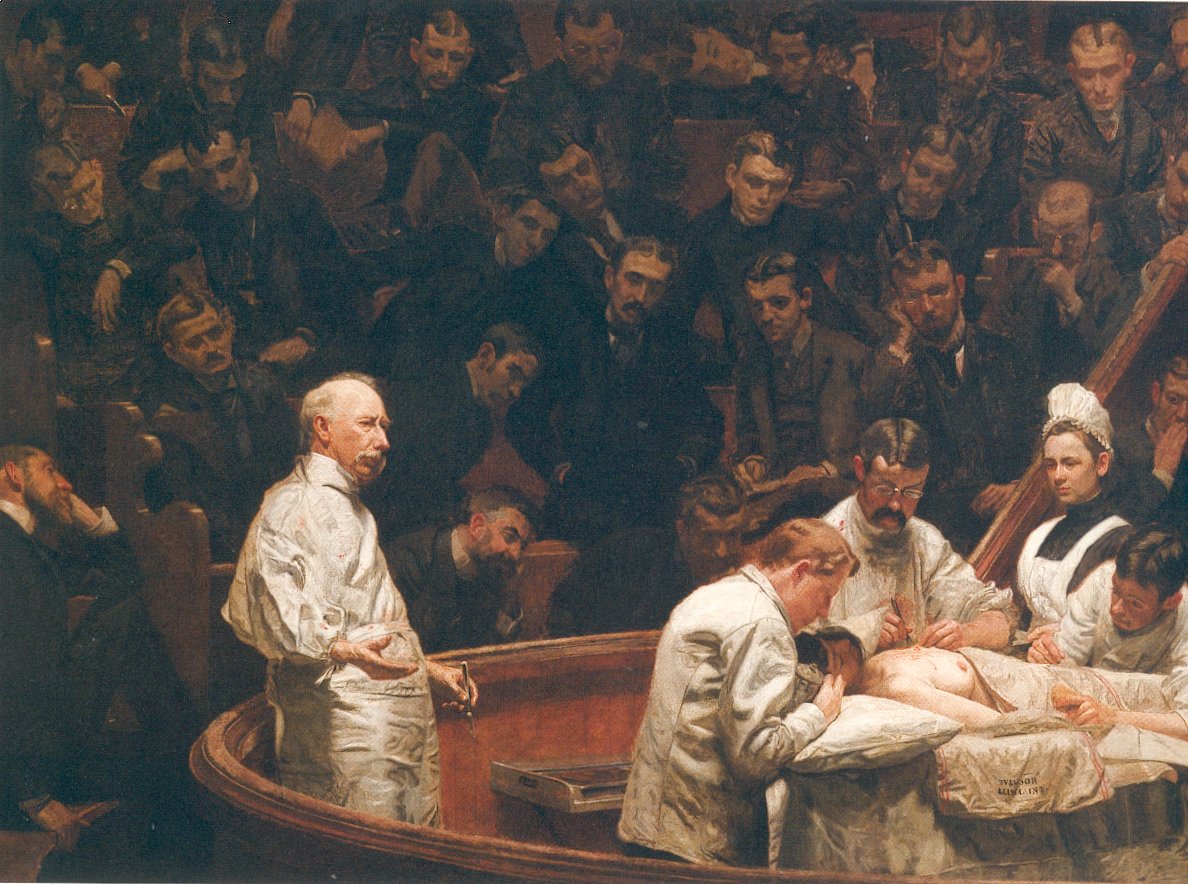
Logan Hall burned on numerous occasions and during at least one fire, one could see an entire skeleton sailing out of the fourth floor window in a desperate attempt to save it and other medical specimens. Before renovation, Logan housed the famous surgery amphitheater of Thomas Eakin's Gross Clinic and Agnew Clinic.
The first faculty of the medical school were from the University of Edinburgh in Scotland. The first ivy planted at the school was brought over from Scotland. To this day, Penn maintains sister status with the University of Edinburgh and bagpipes blow during every commencement.

 Houston Hall (also part of the Perelman Quadrangle) is the first student union building in America. It has gone through many renovations to accommodate the needs of students. The swimming pool is now the Hall of Flags, showcasing all the flags of the Ivy League schools. See if you can figure out which flag belongs to which school!


Some celebrations have stood the test of time. Hey Day signifies the passing of Penn juniors into their last year. Festivities are always marked by the Junior Class march through campus where students wear hats and wave canes in the air. Historically, the hats were made of straw and the canes of mahogany, but today's hat is foam and the cane is bamboo. Tradition demands that juniors take bites of each others' hats.

Ivy Day and Class Day have merged dates with Hey Day but are celebrations for the senior class. Notably, a sprig of Ivy is planted and the graduating class' Ivy Stone is unveiled. Ivy Stones (the oldest example dates from 1873) can be found all over Penn especially on and in buildings. Check out College Hall's outside walls for some really old Ivy Stones!


In the presentation, you get to hear the Penn songs, but unfortunately, there's no way I can currently share them with you -- maybe as mp3 files later. For now you'll have to be satisfied with knowing the major song titles and why they're sung. The Red and the Blue is the school song. It speaks to the story of how Penn got its colors. Apparently, during a track meet at Syracuse University, the coach was asked what Penn's colors were. Since the University didn't have any, the coach boasted to the reporter that Penn would take the colors of the teams they beat: Harvard's crimson and Yale's blue.
Drink a Highball is sung after the third quarter of a football game. Penn students would stand and toast the team by drinking a highball (whiskey and ginger ale). After the legal drinking age was raised to 21, the freshman were not allowed to toast. To ameliorate the issue, students stopped drinking a toast and started throwing actual toast on to the football field! Penn has a specialized refitted Zamboni machine which vacuums up all the toast after it is thrown.
The Field Cry of Penn is sung after the football team scores points. Its verses speak to the Civil War (Jeff Davis is Jefferson Davis, confederate president and McGinty was some Navy dude).
Finally, to end our tour of Penn, I'd like to leave you with some notable alumni. In the arts,
One last note: Penn made the mistake of claiming the domain name, upenn.edu, thereby causing a nomenclature debacle. Penn is now often referred to as UPenn (probably due to the choice of URL), frankly a sad state of affairs.
Maybe you're coming to visit Penn. Maybe you're already at Penn. Maybe you're almost graduating and haven't taken the time to learn anything about the place you've been at for years! You could learn all about Penn's history by perusing the university archives. Or, you could join me on a virtual tour of my Penn favorites.
Demystifying Penn Traditions
from a presentation I gave in 2002Founded by Benjamin Franklin, Penn takes its name from William Penn, founder of Philadelphia and Pennsylvania. Penn's coat of arms reflects its founder's and namesake's coat of arms. The animal in the center is a dolphin.


 Penn's seal is the official signature of the University. Thus, you don't really see it on campus, but rather on documents. One place you can see the seal is on south wall of Houston Hall right by the entrance.
Penn's logo like many universities is in Latin. Leges sine moribus vanae has an interesting history. In the late 1800's a student translated the logo then to "loose women without morals" which so distressed the trustees that the logo was eventually changed to the current one. The logo translates to "laws without morals are in vain" which is believed to reflect Horace's statement "
 Soon after the founding of the school, Penn outgrew its buildings in Center City. The story goes that when Ben Franklin was walking on the west side of the Schuylkill River looking for a new place to locate the University, his button popped off! Taking this as a sign, he located the new buildings at this very location.
 Much later a famous sculptor, Claes Oldenburg, heard the story and envisioned a button popping off the Big Ben statue in front of College Hall, landing and splitting right in front of the Van Pelt Library!


One of many of College Hall's interesting stories is that Charles Addams, the creator of the Addams Family, used the building as a model for the Addams mansion (actually, not true, but I'll leave the details out for right now as the Addams Family Mansion and College Hall are remarkably similar!). His widow donated money to PennDesign for their new building, Addams Hall. In the courtyard, you'll find a tribute to the Addams Family!


 Right near College Hall is Claudia Cohen Hall (nee Logan Hall) named after the former wife of Revlon's Ron Perelman. Cohen / Logan Hall was the second building built on the West Philadelphia campus and housed the medical school.
Logan Hall burned on numerous occasions and during at least one fire, one could see an entire skeleton sailing out of the fourth floor window in a desperate attempt to save it and other medical specimens. Before renovation, Logan housed the famous surgery amphitheater of Thomas Eakin's Gross Clinic and Agnew Clinic.
The first faculty of the medical school were from the University of Edinburgh in Scotland. The first ivy planted at the school was brought over from Scotland. To this day, Penn maintains sister status with the University of Edinburgh and bagpipes blow during every commencement.
 Houston Hall (also part of the Perelman Quadrangle) is the first student union building in America. It has gone through many renovations to accommodate the needs of students. The swimming pool is now the Hall of Flags, showcasing all the flags of the Ivy League schools. See if you can figure out which flag belongs to which school!

Some celebrations have stood the test of time. Hey Day signifies the passing of Penn juniors into their last year. Festivities are always marked by the Junior Class march through campus where students wear hats and wave canes in the air. Historically, the hats were made of straw and the canes of mahogany, but today's hat is foam and the cane is bamboo. Tradition demands that juniors take bites of each others' hats.

Ivy Day and Class Day have merged dates with Hey Day but are celebrations for the senior class. Notably, a sprig of Ivy is planted and the graduating class' Ivy Stone is unveiled. Ivy Stones (the oldest example dates from 1873) can be found all over Penn especially on and in buildings. Check out College Hall's outside walls for some really old Ivy Stones!


In the presentation, you get to hear the Penn songs, but unfortunately, there's no way I can currently share them with you -- maybe as mp3 files later. For now you'll have to be satisfied with knowing the major song titles and why they're sung. The Red and the Blue is the school song. It speaks to the story of how Penn got its colors. Apparently, during a track meet at Syracuse University, the coach was asked what Penn's colors were. Since the University didn't have any, the coach boasted to the reporter that Penn would take the colors of the teams they beat: Harvard's crimson and Yale's blue.
Drink a Highball is sung after the third quarter of a football game. Penn students would stand and toast the team by drinking a highball (whiskey and ginger ale). After the legal drinking age was raised to 21, the freshman were not allowed to toast. To ameliorate the issue, students stopped drinking a toast and started throwing actual toast on to the football field! Penn has a specialized refitted Zamboni machine which vacuums up all the toast after it is thrown.
The Field Cry of Penn is sung after the football team scores points. Its verses speak to the Civil War (Jeff Davis is Jefferson Davis, confederate president and McGinty was some Navy dude).
Finally, to end our tour of Penn, I'd like to leave you with some notable alumni. In the arts,
- Marc Platt (producer of Wicked, Silence of the Lambs, & more)
- Lisa Scottoline (lawyer turned novelist)
- Ezra Pound (poet)
- Zane Grey (dentist turned novelist)
- Candace Bergen (actress)
- Hal Prince (producer)
- Louis Kahn (architect)
- John Legend (musician)
- William Henry Harrison (shortest-termed President of the US)
- C. Everett Coop (Surgeon General)
- Ed Rendell (Pennsylvania Governer)
- Arlen Specter (Senator)
- Walter Annenberg (ambassador and philanthropist)
- Ronald Lauder of Estee-Lauder (ambassador)
- Donald Trump and his son
- Ron Perelman, CEO Revlon
Sunday, October 7, 2007
What's a maven?
In The Tipping Point, Malcolm Gladwell indentifies three types of people: the connector, the salesman and the maven. In this blog's iteration of the word, mavens love to gather and dispense information. I believe that we all have an inner maven -- that part of us seeking, exploring, and gathering information. Here you'll find the dispensary of information that I find fascinating.
As posts appear, feel free to tell me if you found the information informative or useful? Share your comments!
~maven
*this is my first foray into blogdom. seriously, being a maven is hard work. dispensing information is more time consuming than gathering it! this is a blog about what i like and think you might find interesting or useful. thanks for reading and sharing the posts!
As posts appear, feel free to tell me if you found the information informative or useful? Share your comments!
~maven
*this is my first foray into blogdom. seriously, being a maven is hard work. dispensing information is more time consuming than gathering it! this is a blog about what i like and think you might find interesting or useful. thanks for reading and sharing the posts!
Subscribe to:
Posts (Atom)